Timber cladding: how one mistake shaped decades of building safety regulations
Project leads
Contributors

Robin Holme
Robin is Director in charge of the Leeds office, bringing experience in project management and monitoring, contract administration, technical due diligence, building pathology and party wall surveying. He also has a keen interest in developing sustainability opportunities across his projects and services.
He has recent experience acting as programme director for high rise cladding remediation works for a leading national student accommodation provider and having completed the RICS EWS1 Assessor course, has enhanced understanding and competence in cladding consultancy. He has led and developed building and project consultancy teams nationally while working in the Leeds marketplace for over 20 years.
Robin’s experience includes new build, refurbishment and fit-out projects as well as managing survey programmes regionally and nationally. His work covers commercial property sectors including industrial, retail, residential, education and healthcare, for clients such as British Land, Patrizia, Land Securities, Quadrant Estates, Walgreens-Boots Alliance, CO-OP, Aberdeen and the Department for Transport.
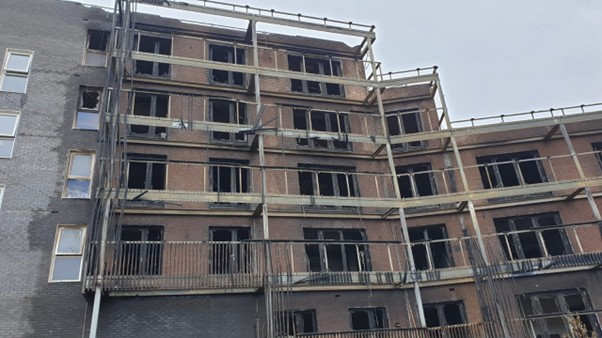
In April 2026, Inside Housing published an article from TFT Technical Designer Ian Abley, explaining how a decades-old mistake has led to the use of 9mm timber cladding on residential buildings. We have now published Ian's full explanation of the causes and implications of this mistake, including diagrams and references, below for those who want to delve deeper into the topic.
The Health and Safety Executive published research from the Real Fires Investigation Project in December 2025 to advise the Building Safety Regulator, on possible amendments to the law of the Building Regulations and the non-mandatory statutory guidance of Approved Document Part B for Fire Safety in England. [1]
That included a previously unpublished experimental report by OFR Consultants from 2024, beginning to characterise Fire hazards of timber cladding. [2] It revealed longstanding Ministry guidance in need of correction by regulators, and the need for action by building owners of existing buildings that may require remediation building works and by developers of new assets.
Learning from ‘Real Fires’ research
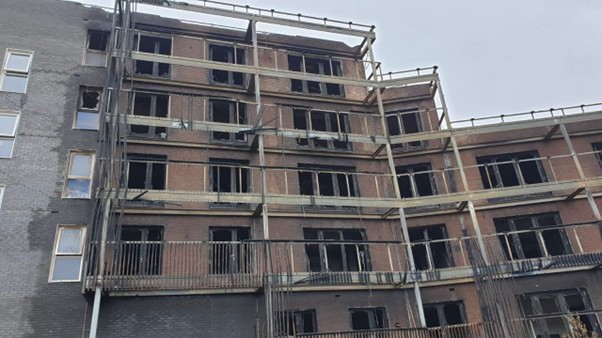
The “Real Fires” research report refers to the incident at Samuel Garside House, 2 De Pass Gardens, Barking Riverside, Barking, IG11 0FQ on 9 June 2019. There were no deaths or serious injuries, with two residents treated for smoke inhalation. But fire spread rapidly across a 20m section of widely spaced timber cladding with timber balconies on the 4, 5 and 6 storey external wall, damaging 30 of the 79 flats before the London Fire Brigade brought it under control. 8 flats were completely destroyed. [3]
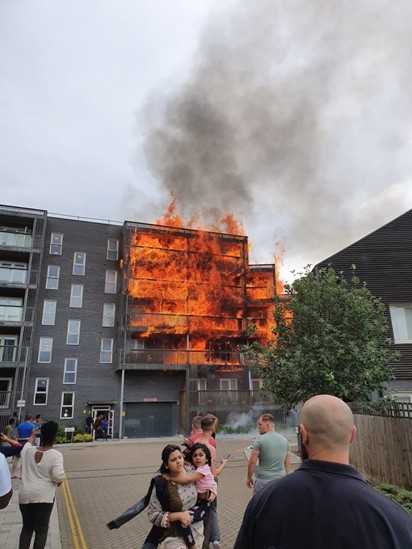
The protracted legal dispute over procedure went to the High Court of Justice, King’s Bench Division, who reported on 25 June 2024, [4] and then to the Court of Appeal, Civil Division, on 8 October 2025. [5] The Court of Appeal allowed the appeal, agreeing the original case had been invalidated by a late service, and set aside the High Court decision. [6] The occupiers of Samuel Garside House were defeated by Bellway Homes Limited on improper procedure, while Sheppard Robson Architects LLP had settled.
Frustratingly, the reality of a timber cladding fire was not in doubt. Subsequent legal disputes confirmed the evidence of the real fire, where combustible external walls like timber cladding do not satisfy Requirement B4(1) in Building Regulations. Which requires “… external walls of the building shall adequately resist the spread of fire over the walls and from one building to another, having regard to the height, use and position of the building.” [7]
One of the three Court of Appeal judges for the Samuel Garside House case was Lord Justice Peter Coulson. In 2023, when referring to the external wall fire at Grenfell Tower on 14 June 2017, where 72 people died and many more were injured by the addition of combustible materials in refurbishment, he had observed:
“Yes, the building failed because, far from resisting the fire, the cladding promoted it. But that is of no comfort to the victims, their friends and families. Specific BR should have prevented the use of such cladding in the first place.” [8]
Creating specific Building Regulations based on Reaction to Fire
Secretary of State James Brokenshire had earlier addressed the prior lack of a “Specific BR”. In the Building (Amendment) Regulations 2018 [9] he specifically amended Building Regulation 7, otherwise generally concerned with Materials and Workmanship. [10] Building Regulation 7(2) of 2018 prescriptively intervened in the post-Grenfell reforms to require external wall materials in high-rise blocks of flats to be Class A2-s1,d0 to BS EN 13501-1 Classification using test data from reaction to fire tests. [11] It limited the amount of fuel available for fires by restricting the calorific value of materials, with a list of practical exclusions in Building Regulation 7(3).
Class A2-s1,d0 materials have a low Gross Calorific Value of <3 MJ/kg. They burn with a minimal quantity of smoke (s) in a range s1 to s3, though disregarding the qualitative aspect of toxicity, and with no burning melting droplets or debris (d) in a range d0 to d2 that could spread fire downwards. It is a specification in the Building Regulations to give legal meaning to the Requirement B4(1) description.
That compares to the Gross Calorific Value of timber species around 15 MJ/kg. Which is a third of the Gross Calorific Value of Aluminium Composite Material with a 100% Polyethylene Core of around 45 MJ/kg, as used in the Rainscreen of the Grenfell Tower refurbishment. A type of Metal Composite Material.
Building Regulation 7(1A) in 2022 [12] proscribed any Metal Composite Material over 35 MJ/kg in all buildings, with that “Specific BR” tested only by calorimetry under BS EN ISO 1716. [13]
Metal Composite Materials are not insulation products, having a high thermal conductivity. They should not be confused with low thermal conductivity Insulated “Sandwich” Panels, often called “Metal Composite Panels”.
The burning surface area of external wall materials is better thought of as MJ/m2. Surface area matters in a real fire, rather than weight. The detailed configuration and fixing are factors, as is the way a composite product delaminates. But Class A2-s1,d0 at <3 MJ/kg is little fuel for a fire, with Class A1 inert materials at a marginally lower Gross Calorific Value of <2 MJ/kg.
Below Class A2 it is possible to obtain a Class B without BS EN ISO 1716 calorimetry by configuring Class E, D or C materials in the “Single Burning Item” test within BS EN 13501-1. Metal Composite Materials with a 100% Polyethylene Core are Class E materials, until configured and fixed to obtain a Class B. Timber cladding is designated as a Class E material and at best may be configured to achieve a Class B rating when treated with some fire retardants.
The Class B problem in the European Reaction to Fire hierarchy was neatly overcome by James Brokenshire in Building Regulation 7(2), by insisting on calorimetry, while recognising exclusions of particular components for practical reasons in 7(3). [14] Although 7(4) limits the scope of 7(2) and 7(3) to residential “relevant buildings” with a storey (not including roof-top plant areas or any storey consisting exclusively of plant rooms) at least 18 metres above ground level.
Surface-painted fire retardants are less reliable than fire retardant impregnated under vacuum pressure throughout the timber, and not all impregnations on the market are equivalent in effectiveness. Impregnated fire retarded timber cladding cannot obtain Class A2 in calorimetry. While Metal Composite Material core types with high mineral content reducing the amount of Polyethylene do achieve Class A2 and A1.
Timber cladding may be fashionable as a “green” material, but fire retardants are often considered unsustainable by environmentalists. Insecticide and Fungicide treatments are another factor of durability, and again vacuum impregnation throughout the timber is more effective than surface-painted coatings. There may be chemical incompatibilities between fire retardants and other chemicals.
Accoya is not a timber species, but the modification of several timber species to improve durability as a non-toxic acetic acid treatment called “acetylation”. The timber at Samuel Garside house was thermally modified. [15] A high-heat process that stops timber being food, and slightly reduces the material as a fuel, improving reaction to fire of “thermowood” to a Class D. Recognised by OFR Consultants in their “Real Fires” report.
Timber needs treatment to delay reaction to fire, deter species of insect attack and depress fungal growth causing wet or dry rot. Which can add to smoke toxicity, though that is conspicuously not a factor in the Building Regulations. While Class A2 and A1 Metal Composite Material manufacturers are trying to regain the popularity that Class E products masquerading as Class B destroyed.
In other buildings outside the scope of 7(4) for 7(2) there is no specific Building Regulation preventing Class E cladding, whether timber or Metal Composite Material, despite Requirement B4(1).
Why is timber cladding approved?
Approved Documents are government published “statutory guidance” showing ways to comply with the Building Regulations. Approved Documents were separated from the law of the Building Regulations in 1985 and need not be followed, as permitted by Section 7 of the Building Act 1984. [16] The promise being that AD-B satisfied the Building Regulations, and notably the legal Requirements in Schedule 1, Part B concerned with fire safety.
OFR Consultants recognise in their “Real Fires” research report that Class E timber cladding can be used on buildings outside of 7(4), where no “Specific BR” prescribes a legal standard over the non-mandatory AD-B.
Despite the precedent of real fires, timber cladding like that at Samuel Garside House can be constructed today, on all non-residential buildings, and on residential buildings that are not high enough to be a “relevant building” in 7(4), even while choosing to follow AD-B.
Timber cladding gets an old exception from current AD-B limits on BS EN 13501-1 classifications. In both volumes of the non-mandatory AD-B, where the Reaction to Fire of materials is classified, there is a long standing note, stating that:
“Timber cladding at least 9mm thick is also acceptable.”
That is Note 3 in Table 10.1 in AD-B Volume 1 for Dwellings and Table 12.1 in AD-B Volume 2 for Buildings other than Dwellings, in the 2019 edition incorporating 2020, 2022 and 2025 amendments which is collated with the 2026 and 2029 amendments. [17] Both Tables are titled “Reaction to fire performance of external surface of walls”, and are identical. Note 3 undermines any non-mandatory limitation in Table 10.1/12.1, including those on residential buildings above and below the 11m threshold.
However, OFR Consultants consider the 9mm dimension an error in the non-mandatory but nevertheless statutory guidance of AD-B. [18] The technically wrong AD-B was earlier explained in the anonymised CROSS Report 1194 Fire performance of timber cladding, published on 20 November 2023. [19] Referred to by OFR Consultants in their “Real Fires” research report.
This acceptance of 9mm timber cladding, which is NOT an acceptance of loadbearing timber structure, is effectively misguidance in AD-B. It poses a problem under Section 7 of the Building Act 1984. It will remain a potential trap if AD-B is not corrected in both Volumes.
Was 9mm timber cladding really a ‘typo’ that went uncorrected?
Prior to AD-B in 1985 the first National Building Regulations of 1965 approved 3/8 inch timber cladding. The Real Fires researchers argue this originates not from policy intent, but from misreading the Fire Research Station Fire Research Note 436 from 1960, available from the International Association for Fire Safety Science archive. [20]
IMAGE 3 - CLOSE UP DRAWING
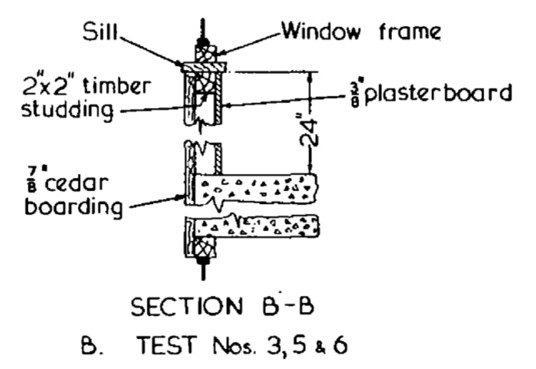
The 1960 testing in FRN 436 was carried out on 7/8 inch cedar boarding, as shown in Figure 4.B. When 9mm is just under 3/8 inch. That may have been confused with the thickness of plasterboard mentioned in the test.
The 3/8 inch exception for timber cladding, then below a height of 50 feet, was in Section E7, Paragraph (3)(b) of the law of the first National Building Regulations 1965, which came into operation on 1 February 1966. [21].
In the Building Regulations 1972 the technically defined legislation was expressed in Metric, and Section E7, Paragraph (3)(b) permitted 9mm timber cladding below a height of 15m. [22]
The misreading of FRN 436, reducing 7/8 inch timber cladding to 3/8 inch, is within Fire Note No 8 Fire and the external wall, published by the Ministry of Technology and Fire Offices’ Committee Joint Fire Research Organization in October 1966. [23] But this is after the Building Regulations 1965. It is unclear if the legislators were influenced by the misreading in FRN 436. But the alternative is that Fire Note No 8 presented a policy decision by legislators as if it came from FRN 436. Fire Note No 8 is not reproduced in the Arup collection of Margaret Law’s pioneering fire engineering papers. [24]
If a 60-year-old mistake which apparently passed without comment, as astonishing as that is, the 9mm timber cladding exception differs from the policy of National Class 0 (number pronounced “zero”) to BS 476 Part 6 and 7 testing, finally withdrawn from AD-B on 2 March 2025. That optional testing had facilitated Metal Composite Materials among other combustible cladding products into the National external wall market.
Class 0 developed from Class O (letter) in the Building Regulations 1965 and 1972. Since 1976 Class O had been policy in the form separated from the law but sustained as Class 0 in AD-B between 1985 and 2019. Both Class 0 and the 9mm timber cladding exception persisted through iterations of AD-B in Diagram 36 from 1991 and Diagram 40 from 2000, before being wrongly transposed to the BS EN 13501-1 hierarchy in 2002, unchanged until 2019. [25]
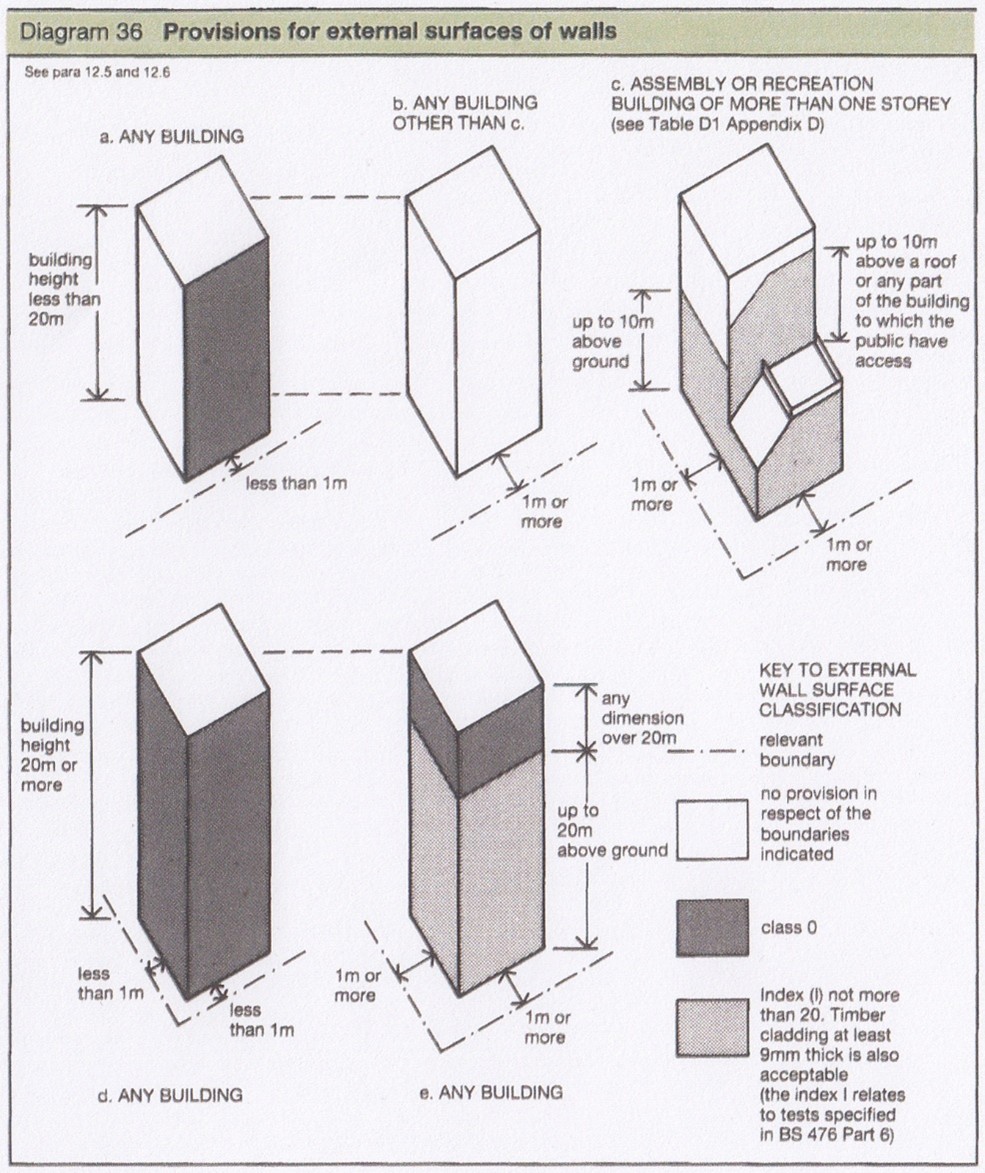
Class 0 as a policy is yet to be explained. That is important when all Metal Composite Materials were marketed as Class 0, among other combustible cladding products that were not thermal insulation. If not a policy, the result of what is claimed to be a ‘typo’ that went uncorrected is that many buildings following AD-B do not reflect the real fire performance of timber cladding.
Both OFR Consultants and CROSS have confirmed the 9mm note is unreliable yet remains in AD B, while continuing to influence design decisions and fire risk assessments. Neither OFR Consultants nor CROSS recommend 22mm timber cladding, as the metric equivalent of 7/8 inch, will necessarily be an adequate specification for Requirement B4(1). They caution about a range of factors in timber cladding that should be considered. But that caution is not as useful as a “Specific BR” for timber cladding.
Fire engineers might object that a “Specific BR” for timber cladding or timber balconies is impossible, because of the variables of species, moisture content, configuration or fire retardant treatment. But that is to dodge the issue which Building Regulation 7(2) confronted with clarity, or to avoid the attempt to justify timber construction under the exclusions list of 7(3). A list that undoubtedly needs improvement through Research and Development.
Correcting the Building Regulations
Since 2022 the Fire Risk Appraisal of External Walls in PAS 9980 has been used to inform fire risk assessments of existing residential buildings. [26] The legacy problem facing residents will not be resolved if fire engineers writing a PAS 9980 FRAEW considers 9mm or 22mm timber cladding to be “tolerable”. PAS 9980 does not correct the legacy of timber cladding at least 9mm thick, insufficient for Requirement B4(1).
In practice PAS 9980 seeks to avoid remediation of construction substandard to Building Regulation 7(2) as the only legislated measure of Requirement B4(1). Without adding anything to 7(3).
A “tolerable” PAS 9980 FRAEW results in a problem for residents inhabiting combustible clad residential buildings and facing ongoing financial uncertainty.
For all buildings and their occupants fire risk assessors may consider external wall construction as “tolerable” even where emerging research shows otherwise. This creates differences in views of reasonable life safety as the qualification in Building Regulation 8 among lenders or insurers additionally concerned with property protection.
Litigation highlighted these issues for Samuel Garside House, though the case failed on procedure. But the time it takes, the costs involved, and the case-by-case results it delivers make it impractical to deal with the number of buildings affected. It will not be wise to expect every timber clad existing building in need of remediation to be addressed by the courts in the absence of any correction of AD-B, or a “Specific BR”.
A straightforward fix would be to withdraw the AD B timber cladding Note 3. in Table 10.1/12.1, just as the BS 476 series was withdrawn in the 2026 and 2029 amendments of AD-B. Instead, timber cladding should be addressed in a “Specific BR” to give technical meaning to Requirement B4(1) in an update of Building Regulation 7, based on published research, for both existing and new building work.
The Approved Document for Regulation 7 has not been updated. [27] A recommended approach is then to universalise Regulation 7(2) which proscribes timber cladding as the “Specific BR” for Requirement B4(1).
This aligns with the approach the insurance sector value in Principle D of the 2023 RISCAuthority guidance for Property Protection, [28] where maximising Class A2-s1,d0 construction is an essential principle for both life safety and property protection. The reasonable life safety limitation on Schedule 1 Part B and AD-B imposed by Building Regulation 8 cannot be ignored. [29]
As the industry awaits updates to Regulation 7(2), or a new specific Building Regulation for all buildings, our advice to clients is to remain alert to this emerging regulatory context when considering timber cladding.
Meanwhile, AD-B is projected to 2029 with amendments, before a further revision is anticipated. [17]
The approval of timber cladding at least 9mm thick in AD-B is likely to be corrected, though it is astonishing it was not addressed for 60 years. Being aware of this trajectory now will help building owners plan proactively and avoid being caught out by future changes.
If new or replacement timber cladding is sought, it should be fire retarded to Class B-s1,d0 using a vacuum impregnated chemical of proven effectiveness, and a minimum thickness of 22mm should be specified.
Replacement of 9mm timber cladding previously thought by AD-B to be sufficient for Requirement B4(1) in the Building Regulations should be considered by building owners. So far as reasonably practicable, of course, timber cladding should be designed out of external wall construction.
A consultation to further amend Approved Document B is now open [30], and any professionals who want to put right loopholes and errors such as those relating to timber cladding, should make their views heard.
This article was first published by Inside Housing Living in shorter form on 23 April 2026. [31]
REFERENCES
[1] HSE, Real fires investigation project, 22 December 2025, https://www.gov.uk/government/collections/real-fires-investigation-project
[2] HSE, Research and analysis, Fire safety: Timber cladding, 22 December 2025, https://www.gov.uk/government/publications/fire-safety-timber-cladding
[3] Barking Riverside Fire, Resident-led Inquiry, London Fire Brigade, Full Report, Samuel Garside House, Date of Incident 9 June 2019, LFB Incident Number 072738-09062019, 16 November 2019, https://barkingriversidefire.com/wp-content/uploads/2020/05/LFB-full-FI-Report-Incident-No.-072738-09062019-Samuel-Garside-House-IG11-0FQ-REDACTED_Redacted.pdf-_9287188_1.pdf
[4] High Court of Justice, King’s Bench Division, The Occupiers of Samuel Garside House v Bellway Homes Limited and Sheppard Robson Architects LLP, Case No: QB-2022-001762, Neutral Citation Number: [2024] EWHC 1579 (KB), reported 25 June 2024, https://caselaw.nationalarchives.gov.uk/ewhc/kb/2024/1579/data.pdf
[5] Court of Appeal, Civil Division, Bellway Homes Limited v The Occupiers of Samuel Garside House, 8 October 2025, https://www.judiciary.uk/live-hearings/bellway-homes-ltd-appellant-v-the-occupiers-of-samuel-garside-house-respondent/ available https://youtube.com/live/0DrOtc3bpjQ
[6] Court of Appeal, Civil Division, Bellway Homes Limited vs The Occupiers of Samuel Garside House, Case No: CA-2025-000771, Neutral Citation Number: [2025] EWCA Civ 1347, reported 23 October 2025, https://www.bailii.org/ew/cases/EWCA/Civ/2025/1347.pdf
[7] The Building Regulations 2010, Schedule 1 Requirements, External Fire Spread, B4.-(1), https://www.legislation.gov.uk/uksi/2010/2214/schedule/1
[8] Rt. Hon. Lord Justice Peter Coulson, From Ronan Point to Grenfell: The Decline and Fall of Building Safety, Paragraph 94, Page 37, 28 March 2023, https://d34xi2cisccwsg.cloudfront.net/resources/Keating-Chambers-Flagship-Lecture-Paper-From-Ronan-Point-to-Grenfell.pdf
[9] Building (Amendment) Regulations 2018, Statutory Instrument No. 1230, https://www.legislation.gov.uk/uksi/2018/1230/made
[10] Building Regulations 2010, Statutory Instrument No. 2214, Regulation 7 Materials and Workmanship, https://www.legislation.gov.uk/uksi/2010/2214/regulation/7
[11] BS EN 13501-1: 2018 Fire classification of construction products and building elements - Classification using data from reaction to fire tests, https://knowledge.bsigroup.com/products/fire-classification-of-construction-products-and-building-elements-classification-using-data-from-reaction-to-fire-tests
[12] Building etc. (Amendment) (England) Regulations 2022, Statutory Instrument No. 603, https://www.legislation.gov.uk/en/uksi/2022/603/made
[13] BS EN ISO 1716: 2018 Reaction to fire tests for products. Determination of the gross heat of combustion (calorific value), https://knowledge.bsigroup.com/products/reaction-to-fire-tests-for-products-determination-of-the-gross-heat-of-combustion-calorific-value-1
[14] Centre for Window and Cladding Technology and the Society of Façade Engineering, Technical guidance for interpretation in relation to the external walls and specified attachments of Relevant Buildings in England, Issue 2, July 2023, https://www.cwct.co.uk/pages/cwct-sfe-fire-guidance
[15] Jack Simpson, Revealed: the type of cladding used on Barking block destroyed in fire, Inside Housing, 10 June 2019, https://www.insidehousing.co.uk/news/revealed-the-type-of-cladding-used-on-barking-block-destroyed-in-fire-61848
[16] Building Act 1984, Chapter 55, Section 7 Compliance or non-compliance with approved documents, https://www.legislation.gov.uk/ukpga/1984/55/section/7
[17] Ministry of Housing, Communities and Local Government, Statutory guidance, Fire safety: Approved Document B, 7 December 2010, last updated 11 March 2025, https://www.gov.uk/government/publications/fire-safety-approved-document-b
[18] OFR Consultants, Multi-scale characterisation of the fire hazards of timber cladding (Phase 1 and 2), Project Number: OX21041 for the Health and Safety Executive, 2.2.1 ADB guidance relating to 9 mm timber, Page 13, 26 September 2024, https://assets.publishing.service.gov.uk/media/68dbd0be8c1db6022d0c9f2b/fire_hazards_of_timber_cladding.pdf
[19] CROSS Report 1194 Fire performance of timber cladding, 20 November 2023, https://www.cross-safety.org/uk/safety-information/cross-safety-report/fire-performance-timber-cladding-1194
[20] L.A. Ashton and H.L. Malhotra, Fire Research Station, Fire Research Note 436, The protection of openings against spread of fire from storey to storey, 1960, available from the International Association for Fire Safety Science archive, https://publications.iafss.org/publications/frn/436/-1 and https://publications.iafss.org/publications/frn/436/-1/view/frn_436.pdf
[21] Building Regulations 1965, Statutory Instrument No. 1373, Section E7, Paragraph (3)(b) https://www.legislation.gov.uk/uksi/1965/1373/made
[22] Building Regulations 1972, Statutory Instrument No. 317, Section E7, Paragraph (3)(b) https://www.legislation.gov.uk/uksi/1972/317/made
[23] G.T. Langdon-Thomas and M. Law, Ministry of Technology and Fire Offices’ Committee Joint Fire Research Organization, Fire and the external wall, Fire Note No 8, HMSO, London, October 1966
[24] Arup, Engineering Fire Safety: some selected papers from Margaret Law, republished 2017, https://www.arup.com/insights/engineering-fire-safety-some-selected-papers-by-margaret-law/
[25] https://www.gov.uk/government/publications/historical-documents-relating-to-approved-document-b-fire-safety
[26] BSI, PAS 9980: 2022 Fire Risk Appraisal of External Walls and Cladding of Flats, https://www.bsigroup.com/en-GB/insights-and-media/insights/brochures/pas-9980-fire-risk-appraisal-of-external-walls-and-cladding-of-flats/
[27] Ministry of Housing, Communities and Local Government, Statutory guidance, Material and workmanship: Approved Document 7, 3 January 2013, Last updated 29 November 2018, https://www.gov.uk/government/publications/material-and-workmanship-approved-document-7
[28] Fire Protection Association, RISCAuthority BDM01 A to Z of Essential Principles for the protection of buildings, Version 3, 13 February 2023, https://www.thefpa.co.uk/resource-download/234
[29] Building Regulation 2010, Statutory Instrument No. 2214, Section 8 Limitation on requirements, https://www.legislation.gov.uk/uksi/2010/2214/regulation/8
[30] HSE - Review of Approved Document B: Fire Safety, Opened 25 March 2026 and Closes 1 July 2026, Updated 15 April 2026, https://consultations.hse.gov.uk/bsr/review-of-approved-document-b-fire-safety/
[31] Ian Abley, Timber cladding: dealing with an apparent 60-year mistake, Inside Housing Living, 23 April 2026, https://living.insidehousing.co.uk/comment/timber-cladding-dealing-with-an-apparent-60-year-mistake-96692
Related content


We make buildings work better

