Daylight and sunlight assessments in Dublin: a cautionary tale for planning submissions
Project leads
Contributors

Richard Nosworthy
Richard Nosworthy heads up the Neighbourly Matters team, which comprises of Daylight, Sunlight, Rights of Light Consultancy, Party Wall advice, Boundary Disputes and Oversailing Licence services. He is a highly dedicated and conscientious advisor, who has a proven track record for delivering expert strategic Rights of Light/Planning Daylight & Sunlight advice for developers, financial institutions and government bodies in some of the UK’s most challenging locations.
Richard works on daylight, sunlight and rights of light issues for major mixed-use developments, large residential developments and a variety of other projects for top UK investors. He supports overall planning strategies by delivering the largest possible massing whilst minimising impacts to neighbouring properties.
Notable projects include large mixed-use residential schemes such as the redevelopment of former Honey Monster Factory (Quayside Quarter) providing 1,997 residential units over nine blocks, up to 29 storeys. Richard also advises central Local Authorities, such as Camden and Tower Hamlets, in relation to their own redevelopment schemes and providing advice on third party developments.

Sarah McDonnell
Sarah is Director of Project Management for the TFT Dublin office. She brings over 25 years of industry experience to TFT and has worked on a wide range of work overseeing all project management processes from purchase, through to design development and construction contract completion.
Her extensive experience includes projects across all industry sectors. Prior to joining TFT, Sarah worked on both client side for a prominent Irish property developer and also leading the refurbishment and Fit-Out division of one of Ireland's leading contractors.
Past clients include IPUT, Willis, JP Morgan, Google, KPMG and Hines. Outside of the office, Sarah sits on the Board of ALONE, a charity dedicated to enabling older people to live independently at home and is also on the judging panel for the Irish Construction Excellence Awards.
Daylight and sunlight compliance in Ireland
Historically, daylight and sunlight has rarely been an issue in Ireland. Now, with increased density and development, it is something all developers need to properly consider when seeking redevelopment within built up areas like Dublin.
A 2025 High Court ruling has brought this into focus, and highlighted the risks of misapplying the Building Research Establishment (BRE) guidelines when preparing submissions.
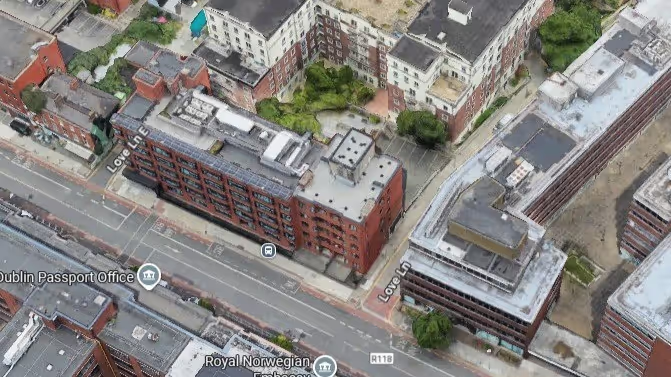
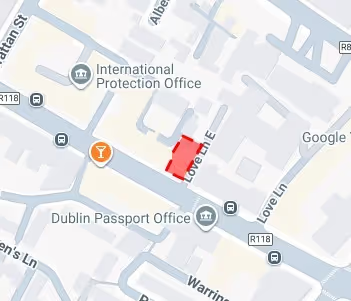
In Dublin City Council Planning Application Ref: 2872/20, approval for a major city-centre development was overturned following a successful challenge by residents. The court found that the planning officer’s report (based on the consultant’s findings) was materially misleading, which led to the withdrawal of planning permission.
This case is the first in Ireland where a decision was reversed due to incorrect application of BRE’s Site Layout Planning for Daylight and Sunlight: A Guide to Good Practice. It draws parallels with the well-known Rainbird v London Borough of Tower Hamlets case in England, underlining the importance of robust, evidence-based daylight and sunlight analysis.
Key lessons for developers and planning authorities
The judgment sends a clear warning to both developers and planning boards:
• Do not accept conclusions at face value. Always review the underlying technical evidence.
• Appoint qualified consultants. Ensure they have the expertise to correctly apply BRE guidance and justify any deviations.
At TFT, we have over 25 years of experience delivering daylight and sunlight assessments that withstand scrutiny. When questions arise, our reports provide robust, defensible responses.
Common pitfalls in daylight and sunlight assessments
Here are the main stumbling blocks that led to the overturned decision, and how to avoid them:
1. Incorrect daylight thresholds
BRE recommends a Vertical Sky Component (VSC) of 27% at the window centre or retention of 0.8 times the former VSC value. While BRE guidelines allow flexibility, alternative targets must be justified - usually by referencing local context or precedent. For example, in dense city locations, a lower contextual VSC baseline may be reasonable, but this must be supported by evidence.
2. Omission of affected windows
Only windows serving habitable rooms need assessment, but consultants must verify room use before excluding windows. Indicators such as obscured glazing, pipework, and personal items can help identify bathrooms or circulation spaces. Failure to research room layouts can undermine the credibility of your report.
3. Insufficient survey data
Accurate land survey data significantly improves modelling precision. Where assumptions are necessary, they should be clearly stated and supported by research. BRE assessments are comparative, so minor tolerances are acceptable—but transparency is key.
.avif)
How to safeguard your planning application
This case could have been avoided with expert advice. A report grounded in BRE guideline targets, supplemented by context-based justification for alternative thresholds, enables informed decision-making and reduces risk of challenge.
Read more from Richard Nosworthy on the case, here.
Get advice for daylight and sunlight in Ireland
Our dedicated Daylight and Sunlight team provides robust, defensible assessments for planning submissions across Ireland.
With offices in Dublin and Belfast, we offer local expertise backed by decades of experience.
Contact Richard and Sarah today for help on your planning application and advice on applying BRE guidance in the right way.
Related sector
Related services

Related content




We make buildings work better

