UKGBC launches Whole Life Carbon Framework
Project leads
Contributors

Gemma McKenzie-Rodgers
Gemma is TFT’s Associate Director of Sustainability for the UK& Ireland. With 20+ years’ experience in environmental management, sustainable building design, and ESG, she supports owners, occupiers and investors in understanding and improving the sustainable performance of their assets. Managing our in-house team of energy, carbon and sustainability specialists, Gemma supports clients to embed sustainability across portfolios in line with planning obligations, corporate aspirations, and industry best practice, aligning to CapEx/OpEx strategies, from concept through to completion.
Her expertise includes developing corporate sustainability strategies, leading green procurement, and delivering certified buildings and wellbeing standards across new build, refurbishment, and fit-out projects. Gemma also oversees technical studies such as EPC and MEES, net zero carbon, whole life carbon, and circular economy, supporting clients through planning and asset transactions.

Neil Granger
Neil is Head of Sustainability, based in TFT's Edinburgh office. He has over 25 years of experience in building services, sustainable design and technical management for domestic and international projects across a number of sectors.
Neil has undertaken several framework lead roles for building services engineering services, with experience in both public and private sectors. He has also led individual projects out of these frameworks, both as a design manager and technical lead, including new academies for Aberdeenshire Council and global manufacturing facilities for General Electric.

Our industry knows more than ever about what decarbonisation is, and why the built environment needs to contribute to it.
Now, with the launch of the UK Green Building Council (UKGBC)'s new Whole Life Carbon Framework, we have practical guidance on how to achieve it.
TFT helped to create this updated version of the Whole Life Carbon Framework, to make it easier for our industry to act on minimising whole life carbon and residual emissions across a building’s entire lifecycle. The work combines principles for whole life carbon reduction with prompts on how to apply it to real buildings and projects.
The UKGBC's original Net Zero Carbon Buildings Framework (2019), set the stage for this guidance, by clarifying the high-level definition and delivery of net zero carbon buildings.
Now, as the Intergovernmental Panel on Climate Change (IPCC) calls for urgent and deep emissions reductions to limit global warming to 1.5°C, this guidance is essential to give the built environment the tools to tackle both operational and embodied carbon emissions across all asset types.
We’re glad to be part of the programme with the UKGBC and our fellow project partners. Together, we're committed to creating the conditions for our clients and wider industry to embed whole life carbon thinking into every stage of a building's lifecycle.
There is still much to do, but frameworks like this help create the shared direction and practical tools we need.
Find out more about the framework, here.
Want to know how the framework has changed and what it can do for you? Read on.
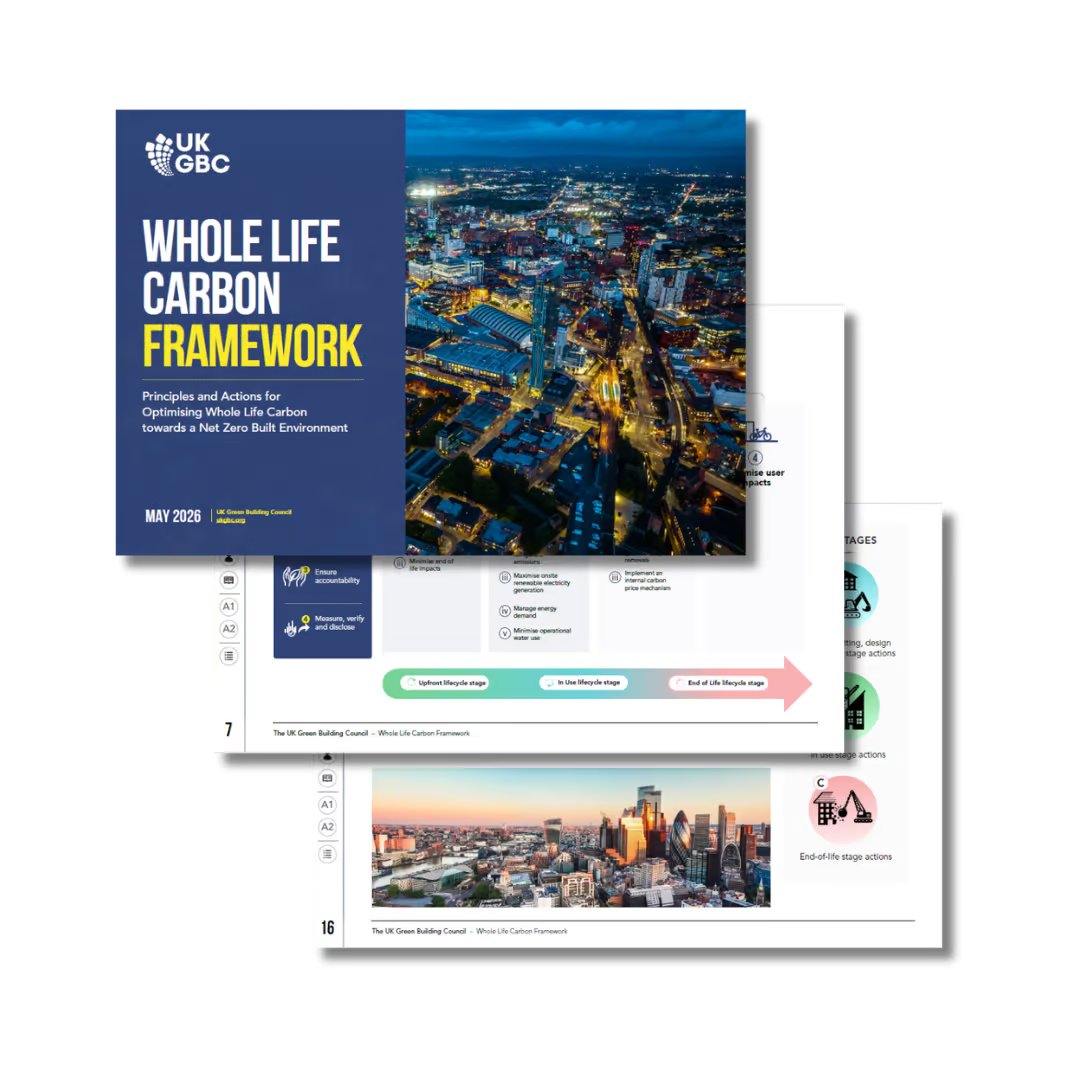
FAQs: Understanding the UKGBC Whole Life Carbon Framework
What is the new framework?
In May 2026, the UKGBC published its Whole Life Carbon (WLC) Framework to replace its 2019 Net Zero Carbon Buildings Framework. The new guidance reflects how far the industry has progressed and provides more detailed, practical direction to decarbonise across a building’s lifecycle.
What’s changed since 2019?
The 2019 framework played a critical role in establishing a shared definition of net zero carbon buildings. Since then:
- Whole life carbon assessments have become much more widespread
- Methodologies such as the RICS Whole Life Carbon Assessment standard have matured
- The UK Net Zero Carbon Building Standard (UKNZCBS) has been introduced
The new framework takes us from “what is net zero?” to “how do we achieve it?”, which aligns closely with the UKNZCBS delivery pathway.
What is the biggest shift in approach?
The most significant change is the move away from focusing primarily on operational carbon. The framework now promotes optimisation across the entire lifecycle, including:
- Upfront embodied carbon (A1–A5)
- In-use embodied carbon (B1–B5)
- Operational carbon (B6–B7)
- End-of-life impacts (C1–C4)
This whole life perspective encourages project teams to consider trade-offs across all stages, rather than optimising one area in isolation.
How does it work alongside the UK Net Zero Carbon Building Standard?
The relationship is complementary:
- UKNZCBS sets performance limits, definitions, and verification requirements
- WLC Framework provides the principles, actions, and decision-making guidance to meet them
What principles underpin the framework?
The framework introduces two sets of core principles:
Overarching principles
- Act today and stay adaptable
- Set objectives and targets
- Ensure accountability
- Measure, verify and disclose
Delivery principles
- Minimise embodied carbon
- Optimise operational carbon
- Manage residual emissions
- Optimise user impacts
Together, these create a structured yet flexible approach to decision-making across the lifecycle.
How should project teams use the framework?
The framework provides stage-by-stage actions aligned to the RIBA Plan of Work. Highlights include:
Early stages (RIBA 1–2)
- Balance embodied and operational carbon from the outset
- Undertake pre-demolition/refurbishment audits to enable reuse
- Design for disassembly and future recovery
- Adopt a fabric-first approach to energy performance
- Consider embodied impacts of systems (e.g. PV break-even)
- Select low-carbon, fossil-free heating solutions
- Set material efficiency targets early
Design and procurement (RIBA 3–4)
- Engage the supply chain to improve material efficiency
- Track carbon-related design decisions
- Embed carbon targets within contracts
- Reduce construction waste at source
- Plan logistics to support reuse
Construction and handover (RIBA 5+)
- Monitor and report embodied carbon (A4/A5) regularly
- Ensure compliance with carbon targets and EPD submissions
- Deliver high-quality commissioning and post-occupancy evaluation
- Provide robust operational guidance to building users
- Develop a detailed end-of-life carbon assessment
How do you verify compliance?
To demonstrate compliance with the WLC Framework and UKNZCBS, independent verification by Bureau Veritas is required.
This has implications for:
- Project costs
- Programme timelines
- Early-stage planning
Project teams should factor this in as early as possible.
The evolution of sustainability in the built environment
As the built environment continues to adapt, becoming more familiar with sustainability goals and how to attain them, the Whole Life Carbon Framework provides a vital roadmap. It moves the industry beyond ambition and definition, towards delivery and accountability.
With collaboration across organisations like UKGBC, TFT and our fellow project partners - LandSec, BNP Paribas and Winvic - the sector is better equipped than ever to deliver meaningful, measurable change.
Related sector
Related services

Related content



We make buildings work better

